Bringing you the outcomes from the first project output
These days all the project partners have been working on the first intellectual project output, including the detailed design of a package of a career guidance and development services for low-skilled workers together with user manuals for their operators. Following are some intermediate outcomes from the process of creating this output. To this end, each partner country focused on one industry and examined it in greater detail by using the PESTEL method.
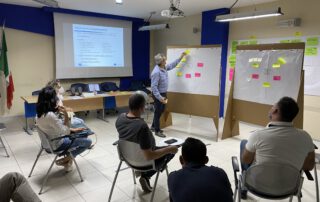
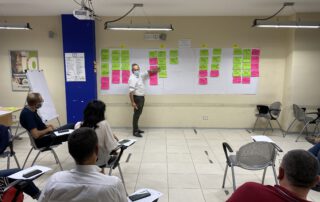
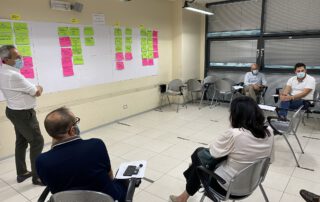
In Italy, the partners work in the window and door frame sector. The PESTEL analysis results allowed Italian partners to draw three “evolutionary scenarios of the sector” referred to three slots of future time. From these scenarios, they worked with a group of SMEs associated with CAN. They defined the emerging Skills Roadmap. The emerged skills needs are partly related to new technologies and customer service.
Subsequently, in-depth observation of the condition of low-skilled workers of SMEs was carried out. In summary, it emerged that the low-skilled workers are not aware of the risks of leaving the labour market. They are willing “to put themselves in the game” if they will obtain economic benefits. Entrepreneurs and experts have a more pessimistic view of the self-perception of low-skilled workers.
From the results of the Czech Republic PESTEL analysis, it can be seen that the ratio of opportunity and threat to lose a job for low-skilled workers in automotive industry is unbalanced according to selected factors. Electromobility and consumer trends in the purchase of cars create opportunities for differentiation for manufacturers and possible competitive advantage. Industry 4.0 (digitalization and robotization) is an opportunity that can revolutionize overall production and affects intensively also low-skilled workers in this industry.
Based on the observation results on the condition of employed and unemployed adults in the Czech Republic, the situation is stable, and the demand for low-skilled vacancies is increasing. The low-skilled workers in the automotive industry do not perceive the risk situation as the demand outweighs the supply of their working places, and the working conditions seem to be good.
In the Czech Republic, the low-skilled workers are aware of their skills but unfortunately, they are not aware of the skills useful to businesses that will change within the next five years. Although they know the types of jobs and skills that are demanded in the industry, they are satisfied with their current jobs.
Managers or entrepreneurs and experts perceive that there should be the most improvement in maintaining low-skilled workers’ physical and emotional well-being, which is the same as the low-skilled workers do, but also feel these workers need to improve taking their initiative and managing their own time and information without being distracted.
The German PESTEL analysis focused on the tourism sector. For the state of Mecklenburg-Vorpommern in particular, the industry represents an important branch of the economy. Thus, about 18% of all employed persons in this region work in gastronomy areas, hotel businesses, and other providers of tourist services.
Due to the Corona pandemic and the long closures of almost seven months, the situation for small and medium-sized enterprises is very tense. In addition to financial hardships, the skilled labour problem is the biggest challenge. Even before Corona pandemic, this was a major problem. Many apprenticeships and jobs – especially in rural areas – remained unfilled. Many skilled workers have also migrated to other sectors in recent months due to the many uncertainties, or are planning to do so. According to industry figures, one in ten skilled workers has left the tourism sector permanently.
As a result, it can be noted that the concern of losing one’s job due to the tense economic situation is present, yet the certainty of being able to change to other employers in the region is great. Employees, as well as employers and experts, agree that digitalization and sustainability will change offers and services in the tourism sector. However, jobs are not in danger per se. The developments offer much more the opportunity to focus on essential tasks such as customer care, service quality, etc.